A sump pump is not the right solution for every wet basement — but for some basements, it is the only solution that actually works. Knowing which situation you are in is the difference between solving the problem permanently and spending money on the wrong fix.
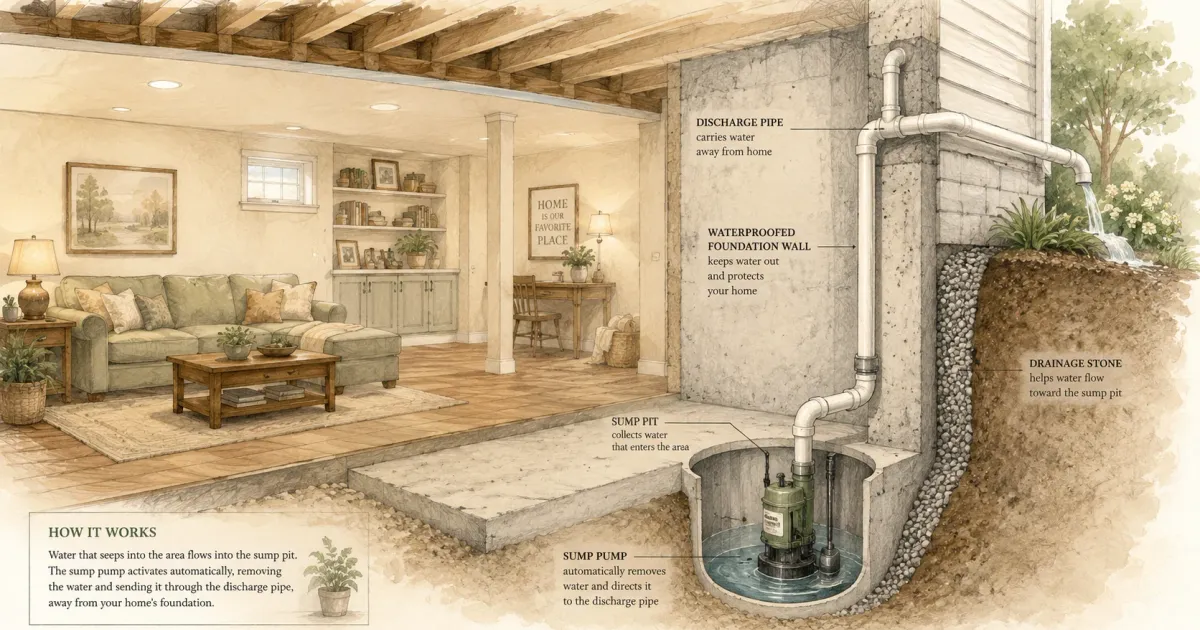
The core job of a sump pump is to collect groundwater that accumulates around or beneath the foundation and discharge it away from the home. It sits in a pit — the sump basin — dug below the basement floor, and activates automatically when water in the pit reaches a set level. What it does not do is stop water from seeping through cracks in foundation walls, fix poor exterior drainage, or address condensation. Understanding that distinction helps you determine whether a sump pump is what your basement actually needs.
- Signs your basement likely needs a sump pump
- When a sump pump is not the right solution
- What installation involves
- What to do if you are not sure
Signs your basement likely needs a sump pump
These are the conditions that consistently point toward a sump pump being the right tool for the job.
Standing water or flooding after heavy rain or spring snowmelt. If your basement takes on water following significant precipitation — particularly during Minnesota's spring thaw, when frozen ground cannot absorb snowmelt quickly — a sump pump addresses exactly this: groundwater that rises and needs to be moved. The University of Minnesota Extension's moisture guide explains the mechanics of how groundwater enters below-grade spaces, which can help identify whether your situation is surface water or deeper groundwater intrusion.
Efflorescence on basement walls. White or gray chalky deposits on concrete or block walls are a reliable indicator that water is migrating through the foundation material. Efflorescence is the mineral residue left behind as water evaporates after passing through porous concrete. It tells you water is moving through the wall regularly, and if that water is accumulating at the footing, a sump pump may be needed to relieve the hydrostatic pressure building up around the foundation.
Persistent musty smell without visible water. A basement that consistently smells damp even when you cannot find standing water is often dealing with chronic humidity above 60 percent. Some of that moisture comes from groundwater influence. If the humidity returns regardless of how often you run a dehumidifier, the source may be below the slab.
Low-lying lot or flat grade. Homes on flat or low-lying terrain have nowhere for surface and subsurface water to drain naturally. If your property sits at or below the level of the surrounding ground, water tends to migrate toward your foundation rather than away from it.
Clay-heavy soil. Much of the Twin Cities metro sits on glacial till — clay-heavy soil that absorbs water slowly and holds it near the surface for extended periods. Homeowners in parts of Dakota, Scott, and Washington Counties in particular frequently encounter high water tables and slow drainage conditions that make sump pumps a practical necessity rather than an optional upgrade.
Neighboring homes already have sump pumps. A neighborhood full of sump pumps is a reliable signal about the local water table and soil conditions. If your neighbors on both sides are running pumps and yours does not have one, that information is worth taking seriously.
An existing pit that was capped or removed. If you find a sealed concrete circle in your basement floor, or a PVC cap covering a hole, previous owners recognized the need and either had a pump that failed or removed it without addressing the underlying condition.
When a sump pump is not the right solution on its own
A sump pump handles water once it reaches the pit. It does not address the conditions that allow water into your basement in the first place. These situations call for different solutions — or need to be fixed alongside a sump pump:
Poor exterior grading. If the soil around your foundation slopes toward the house rather than away from it, surface water is being directed at your basement walls. Regrading the yard to slope six inches over the first ten feet from the foundation is the correct fix, and it should happen before or alongside any pump installation.
Clogged or misdirected gutters and downspouts. Roof runoff deposited next to the foundation is a surface water problem, not a groundwater problem. Extending downspouts and cleaning gutters addresses this without a pump.
Foundation wall cracks. Water entering through a crack in the wall is surface or subsurface water finding a path of least resistance. Sealing the crack with hydraulic cement or epoxy injection stops the entry point — a sump pump in the pit does not address this and may not prevent the water from getting into the wall cavity.
Condensation. If moisture is forming on cool basement walls and pipes during humid summer months, that is a different problem from groundwater infiltration. Insulation and vapor barriers address condensation; a sump pump does not.
The diagnostic question is: where is the water coming from? If it is rising up from beneath or through the floor slab, a sump pump belongs in the solution. If it is coming through the walls or forming through condensation, other interventions should come first.
| Moisture source | Likely cause | Right solution |
|---|---|---|
| Water rising through or seeping up from floor | High water table or groundwater | Sump pump |
| Water seeping through foundation wall cracks | Surface water finding a path | Crack sealing (hydraulic cement or epoxy injection) |
| Pooling near foundation after rain | Yard slopes toward house | Regrade yard; extend downspouts 4–6 ft from house |
| Wet patches at base of walls after heavy rain | Roof runoff deposited next to foundation | Clean gutters; extend downspouts |
| Persistent moisture or condensation on walls and pipes | Warm humid air meeting cold concrete | Interior insulation and vapor barrier |
What sump pump installation involves
A standard installation involves digging the sump pit in the lowest point of the basement floor, installing a basin liner, setting the pump, and running a discharge line through the foundation wall to terminate several feet away from the home. A check valve on the discharge line prevents water from draining back into the pit when the pump cycles off.
Most residential installations use a submersible pump rated for the volume of water the basement typically encounters, plus a battery backup unit — critical in Minnesota where power outages often coincide with the heavy storms that trigger flooding. A pump that fails during a major rain event is a significant problem, and a backup unit is not optional if the basement contains finished space or stored valuables.
Professional installation is strongly recommended. A correctly sized and installed pump protects the structural integrity of your home; an undersized or incorrectly plumbed unit can fail exactly when you need it most. The Forbes sump pump cost guide is a useful reference for current pricing — typical installation costs range from $1,000 to $3,000 depending on the complexity of the pit, pump capacity, and whether a backup system is included.
What to do if you are not sure
The best starting point is a professional assessment of where the water is actually coming from before committing to any solution. A contractor who works regularly with basement remodeling and waterproofing can evaluate the drainage conditions, soil type, and water entry patterns specific to your home and recommend the right approach — whether that is a sump pump, exterior grading, crack sealing, or a combination.
If you are already thinking through how to keep your basement dry, our guide on keeping a basement dry without a sump pump covers the complementary strategies that work alongside or instead of a pump depending on your situation.
We would be glad to take a look and give you a clear picture of what your basement actually needs.
Frequently Asked Questions
How much does sump pump installation cost in Minnesota?
Most residential sump pump installations in the Twin Cities run $1,000 to $3,000, depending on whether the pit needs to be dug from scratch, the pump capacity required, and whether a battery backup unit is included. Homes with existing pits and intact discharge lines are on the lower end; new installations with backup systems and longer discharge runs are on the higher end. The Forbes sump pump cost guide provides current national benchmarks, though Minnesota labor rates tend to track slightly above average.
Do I need a battery backup sump pump?
For most Minnesota basements, yes. Power outages here frequently coincide with the heavy spring storms and rapid snowmelt events that push water tables highest. A primary pump that loses power at exactly the wrong moment is not a theoretical risk — it is a common failure scenario. If your basement has finished space, stored valuables, or a mechanical room, a battery backup unit is worth including in the original installation.
What is the difference between a sump pump and a French drain?
A sump pump actively removes water that has already collected in the pit by pumping it out and away from the home. A French drain is a passive drainage system — perforated pipe buried in gravel — that intercepts groundwater and channels it toward the pit (or directly away from the foundation) before it can accumulate. The two are often used together: the French drain collects and routes water; the sump pump removes it. Neither system addresses water entering through wall cracks or surface drainage issues.
How do I know if basement moisture is from groundwater or condensation?
A simple test: tape a piece of aluminum foil to the damp wall and seal all four edges with tape. Leave it for 24 hours. If moisture appears on the room-facing side of the foil, the problem is condensation from interior air. If moisture appears on the wall-facing side, water is coming through the wall. Groundwater infiltration through the floor will show up as standing water or wet spots that appear after rain or snowmelt, independent of indoor humidity.