Over-the-range microwaves give you a ventilation system above your cooktop without requiring a separate range hood. But they come with a choice most homeowners make without fully understanding the trade-off: recirculate the air back into the kitchen, or duct it to the exterior.
Neither option is wrong, but they perform differently — and in a remodel where you're already opening walls or cabinets, it is worth making an informed decision rather than defaulting to whatever is easiest to install. This is especially relevant for kitchen remodels where layout changes or appliance upgrades are already in scope.
Recirculating vs. external venting: what each actually does
Recirculating mode passes kitchen air through a charcoal filter inside the microwave, removes some grease particles and odors, and returns the air to the kitchen. It requires no ductwork and is the most common installation because it works in any location regardless of wall access. The limitation is that it does not remove heat, steam, or fine airborne particles — it only filters what passes through the charcoal, and charcoal filters need periodic replacement to remain effective.
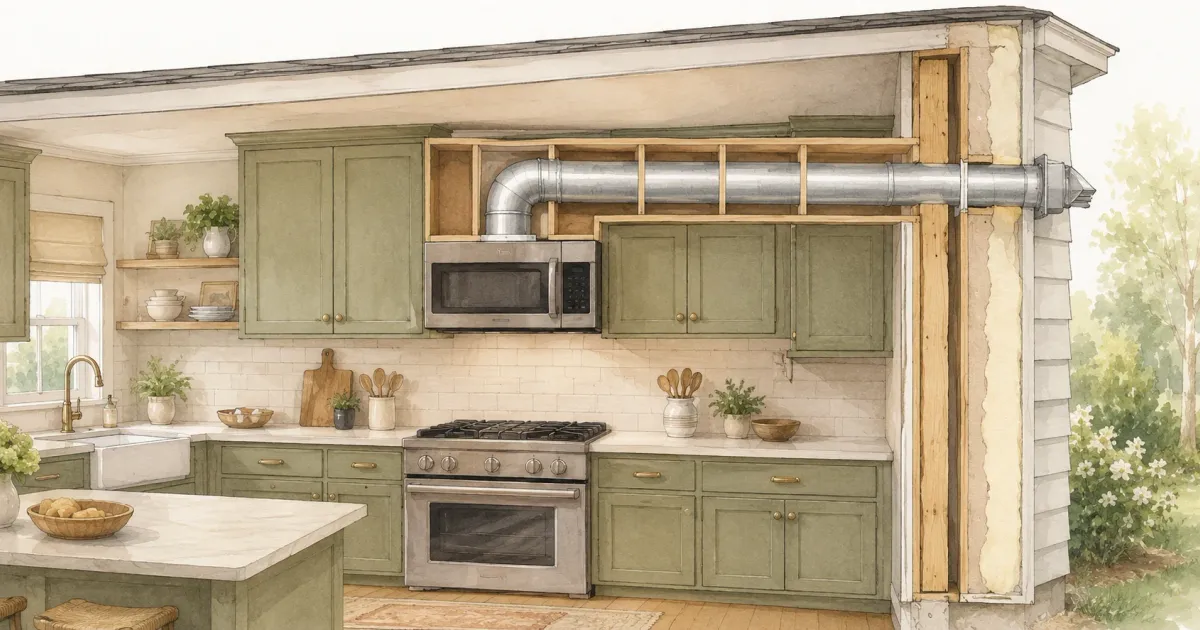
External venting connects the microwave to a duct that carries air out of the home through a side wall or roof cap. This removes heat, moisture, grease, odors, and combustion byproducts directly from the cooking environment. It requires a duct path from the microwave to an exterior termination, which is why it's easier to install during a remodel than to retrofit after the fact.
The difference in performance is meaningful in a kitchen that sees regular heavy cooking. A sauté pan on high heat, a gas burner, or regular frying all generate heat, moisture, and airborne grease at a rate a charcoal filter can't fully address.
Why it matters more than most homeowners expect
Cooking emissions are one of the most underappreciated sources of indoor air quality problems in a home. The EPA's indoor air quality research has documented that gas ranges in particular produce nitrogen dioxide, carbon monoxide, and fine particulate matter during normal operation — at concentrations that can exceed outdoor air quality standards in inadequately ventilated kitchens.
Even with an electric range, cooking oils heated to high temperatures release ultrafine particles and VOCs that accumulate without ventilation. A recirculating filter helps with grease and some odors, but it does not address the full spectrum of cooking byproducts.
This does not mean recirculating mode is a health hazard for most households — it is a code-legal installation for a reason. But if your household cooks frequently, uses a gas range, or has members with respiratory sensitivities, external venting is the more protective choice.
Range hood code and CFM requirements
Most local jurisdictions adopt the International Residential Code or similar standards, which specify minimum ventilation rates for kitchen cooking equipment. Range hood code requirements vary based on whether ventilation is intermittent or continuous, the BTU output of the range, and the jurisdiction's adopted code version.
Over-the-range microwaves are not classified as dedicated range hoods, and code does not universally require them to vent externally. However, if you have a high-output gas range — particularly one with burners exceeding 40,000 BTU — a dedicated range hood with proper CFM capacity may be required or recommended in addition to the microwave.
For a standard residential gas or electric range, an OTR microwave with 300–400 CFM fan capacity in external venting mode meets ventilation expectations for most applications.
Minnesota-specific considerations
Minnesota homes built or significantly updated in recent years are increasingly airtight due to energy code improvements. Tighter envelopes mean kitchen ventilation matters more — cooking byproducts that would have leaked out through gaps in older construction now stay in the conditioned space longer.
External venting in a Minnesota climate also requires attention to the duct termination. The exterior cap needs a tight damper to prevent cold air infiltration when the fan is off. In extreme cold, any moisture in the duct can condense and freeze if the duct is not properly insulated through unconditioned spaces like an attic or exterior wall cavity.
What external venting installation involves
A typical OTR microwave external vent installation requires:
- A duct path from the microwave to an exterior wall or roof penetration — most OTR fans use 3.25" × 10" rectangular duct or convert to 6" round
- An exterior cap with a damper and pest screen, properly flashed if going through the roof
- A reconfigured microwave (most models can switch between recirculating and external venting with a fan motor rotation or adapter kit per the manufacturer's instructions)
- Potentially some cabinet modification or soffit work if the duct needs to run vertically through upper cabinets
The duct path is the main variable. If the microwave sits against an exterior wall and the duct can run straight through to a cap, installation is straightforward. If the path requires going through cabinets, a soffit, or an attic, coordination with a contractor is worthwhile.
When to prioritize external venting
External venting is worth the added work when:
- You have a gas range — combustion byproducts are a more pressing concern than with electric
- You cook frequently at high heat — frying, searing, roasting at high temperatures
- Your kitchen is open-concept — odors and steam carry into living areas without a physical barrier to contain them
- You are already remodeling — ductwork is easiest to run when walls and cabinets are open
Recirculating mode is a reasonable choice when:
- The microwave is on an interior wall with no practical duct path to the exterior
- Cooking volume is light and the range is electric
- The installation is a temporary solution before a more comprehensive kitchen renovation
If you are planning a kitchen remodel and want ventilation addressed as part of the project, we would be glad to help. Getting the ductwork right during a remodel is considerably easier and less costly than adding it after the walls are closed.