The kitchen is more than a place to cook — it's the creative and social center of the home. One of the most effective ways to give it a distinct personality without a full gut renovation is an accent wall.
An accent wall, sometimes called a feature wall, stands out from the others in the room through a unique material, finish, or design. In the kitchen, it earns its place by adding visual interest, breaking up flat surfaces, and introducing texture or utility that the rest of the room lacks.
Think of it the way you'd think of a statement piece in an outfit: it doesn't take over, it anchors.
- Brick and Stone Facades
- Living Plant Walls
- Functional Accent Walls
- Reclaimed Wood Panels
- Artistic Murals
- Interactive Digital Walls
- Three-Dimensional Textured Panels
- Glass and Mirror Installations
Understanding the Accent Wall
The best kitchen accent walls do two things at once. They create a focal point — a surface your eye naturally lands on when you walk in — and they reinforce the design character of the room. That might mean rough texture against smooth cabinets, warm wood against painted surfaces, or a bold material that frames the range or a built-in shelving unit.
What makes it work in a kitchen specifically is that you have natural focal points to work with: the wall behind the range, the end wall in a galley layout, or the wall that faces you from the dining area. The architecture gives you a starting point; the material choice makes the statement.
Eight Kitchen Accent Wall Ideas
Here are eight approaches — from traditional to contemporary — that go well beyond a different paint color.
1. Brick and Stone Facades
Brick and stone read as old-world charm, but they fit comfortably in contemporary kitchens too. The key is contrast: exposed brick behind white cabinets and stainless appliances creates tension in a good way. Natural stone — stacked ledgestone, slate, or limestone panels — brings a more refined texture. Both are durable, heat-tolerant near a range, and age well without looking dated.
Thin-cut brick veneer and panel systems make installation more manageable than full masonry if you're working with an existing wall.
2. Living Plant Walls
A vertical garden brings texture, color, and air-purifying benefits to a space that typically has none of those things on its walls. You can go minimalist — a single row of potted herbs mounted on a rail — or full coverage with a mix of ferns, pothos, and succulents in a modular frame system.
The practical consideration is light and moisture. Living walls near a window work best. If natural light is limited, a system with integrated grow lighting is worth the investment. In a kitchen, drainage management is critical — a closed hydroponic system prevents water damage to the wall behind it.
3. Functional Accent Walls
The functional approach treats the accent wall as a tool rather than decoration. Magnetic panels let you hang pots, pans, and knives without committing cabinet space. Pegboards offer flexible, rearrangeable storage you can customize as your kitchen habits change. A chalkboard surface is a low-cost option that gives you a recipe board, grocery list, and conversation piece in one.
These work especially well in smaller kitchens where every inch of storage counts.
4. Reclaimed Wood Panels
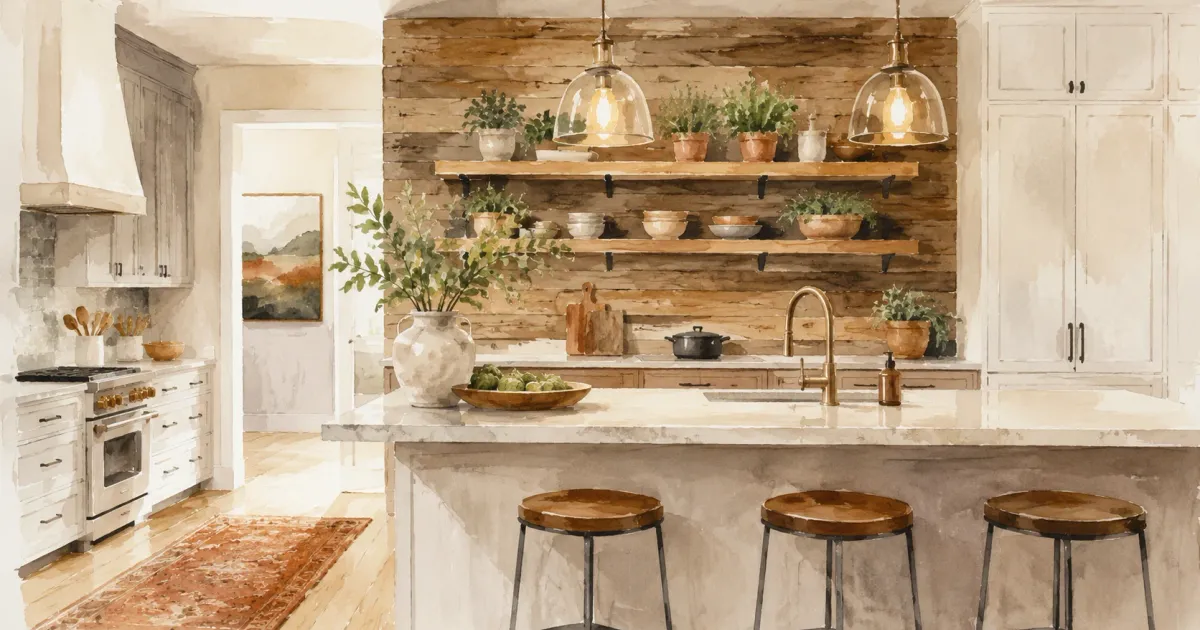
Reclaimed wood brings warmth, texture, and a genuinely one-of-a-kind surface — no two installations look the same. The grain variations, nail holes, and weathered character are what make it interesting. It pairs naturally with open shelving and matte-finish hardware, and it tones down the clinical feel that all-white kitchens can develop.
From a sustainability standpoint, reclaimed material avoids new-growth lumber. From a practical standpoint, properly sealed reclaimed wood holds up well in kitchens. See our guide on wall paneling options if you're weighing different wood-based approaches.
5. Artistic Murals
A hand-painted or printed mural turns the accent wall into a gallery piece scaled to the room. The range is wide: a botanical print, a geometric pattern, an abstract field of color, or a photographic panorama. Custom murals from local artists give the kitchen something no showroom can replicate.
Printed wall murals — high-resolution panels installed like large-format wallpaper — have come down in cost significantly and are a practical alternative to hand-painted work. They're also removable, which matters if you plan to sell within a few years.
6. Interactive Digital Walls
Large-format displays and projector setups can show recipes, ambient visuals, or smart home controls. The technology has matured to where flush-mounted displays look intentional rather than afterthought. Some systems integrate with home automation to adjust ambient lighting alongside the display content.
The primary planning consideration is electrical: outlets, data connections, and ventilation need to be built into the wall before installation. This is best coordinated during a broader kitchen remodel rather than retrofitted later.
7. Three-Dimensional Textured Panels
Three-dimensional panels add depth that paint and wallpaper can't replicate. Wave patterns, geometric reliefs, and hexagonal forms create shadows and highlights that shift as the light changes through the day. Material options include MDF, gypsum, PVC, and bamboo composites — each with different weight, durability, and finish compatibility.
They work especially well as a backdrop for open shelving, where the texture reads behind the objects on the shelf without competing for attention.
8. Glass and Mirror Installations
Mirrors and glass expand a small kitchen visually — a mirrored backsplash or glass panel adds depth the square footage doesn't actually provide. Frosted, tinted, or textured glass adds design interest while still reflecting light. For a warmer option, antiqued mirror panels have a softness that standard mirror doesn't.
Frameless installation reads cleanest in modern kitchens. In a traditional or transitional space, a grid pattern with narrow dividers references classic cabinetry without being literal about it.
How to Choose the Right Accent Wall for Your Kitchen
Eight ideas covers a lot of ground. Here's how to narrow it down.
Budget first. Living plant walls and custom murals are among the more involved options; reclaimed wood and 3D panels vary widely depending on material source. Get a realistic range before you commit to a direction.
Match maintenance to your lifestyle. A living wall requires regular care. A magnetic panel does not. Be honest about how much attention you want to give the wall after it's installed.
Account for the kitchen environment. Heat, humidity, and grease splatter are real factors. Materials near the range need to be heat-tolerant and easy to clean. Digital installations need electrical planning and splash protection. Glass and tile are the most forgiving; untreated wood and fabric-based panels are the least. Architectural Digest notes that kitchen materials with high heat and moisture resistance tend to hold their appearance longest.
Let the light guide the material. A dark reclaimed wood wall reads differently in a north-facing kitchen than in one with south-facing windows. If your kitchen runs dim, reflective materials — mirror, glass, glossy tile — work harder than matte or textured ones.
Consider the rest of the home. The accent wall shouldn't stop at the kitchen doorway in a way that feels jarring from the adjacent room. It should complement the broader palette and material language of the house.
Think long-term, not trend-term. A mural or interactive wall tied to a specific moment has a shorter shelf life than stone, wood, or textured panels. If you're planning to sell within a few years, lean toward materials buyers recognize as durable upgrades. According to Houzz kitchen renovation research, natural and craft-forward finishes — stone, reclaimed wood, handmade tile — consistently score highest in perceived value among buyers.
For anything structural or electrical, plan it into the remodel scope. Accent walls that involve mounting systems, wiring, or drainage work best when coordinated with the overall project rather than added afterward.
Ready to Bring Your Kitchen Accent Wall to Life?
An accent wall is one of the highest-impact changes you can make in a kitchen on a per-square-foot basis — and the right contractor can help you choose a direction that fits your budget, your style, and your long-term goals.
Contact Honey-Doers to talk through your kitchen project. We work with Twin Cities homeowners in Minneapolis, Edina, Eden Prairie, and the surrounding suburbs.